

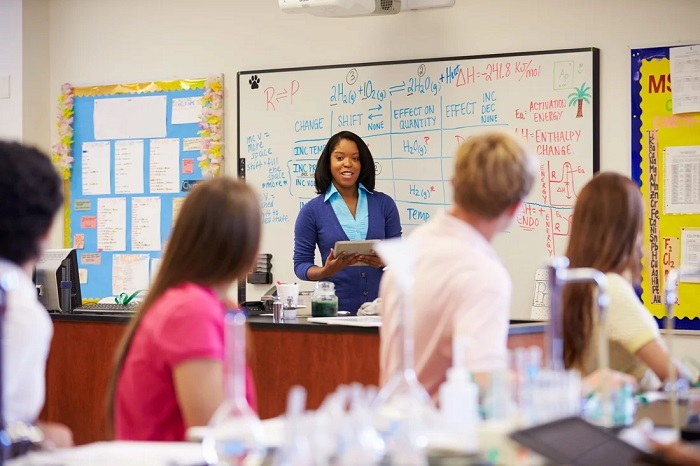
For generations, an orderly, quiet classroom was celebrated as the gold standard of effective teaching. Desks faced forward in rigid rows, teachers delivered carefully prepared lectures from the chalkboard, and students quietly took notes. Yet this peaceful stillness often masks a quiet crisis: passive disengagement. A student can sit motionless for an entire period, nod politely, and leave without ever actively processing the material.
Real comprehension rarely happens through passive absorption. It requires friction, articulation, and cognitive wrestling. When students are invited to voice their observations, defend their reasoning, and interrogate opposing viewpoints, the classroom transforms from a lecture hall into an intellectual laboratory. Purposeful classroom conversation is not a time-filling activity or an entertaining diversion from the curriculum. It is the primary cognitive engine through which deep, lasting understanding is constructed.
Moving Beyond the Traditional Recitation Trap
To understand why meaningful discussion matters, one must first recognize how traditional classroom talk falls short. For decades, the dominant pattern of classroom discourse has followed a rigid loop known as initiation, response, evaluation. The teacher asks a question with a single predetermined answer, calls on the first eager hand, hears a two-word reply, and stamps it with a quick affirmation before moving on.
While this pattern functions well as a rapid compliance check, it does almost nothing to develop critical thinking. The teacher remains the sole conversational hub and the ultimate arbiter of truth. Students do not listen to their peers; they wait for the teacher to validate or dismiss whatever was just said.
Shifting to dialogic learning requires breaking this predictable circuit. Instead of functioning as an inquisitor who quizzes students on memorized facts, the educator becomes a facilitator who prompts students to talk directly to one another. When the teacher responds to a student’s answer with “Why do you think that holds true?” or “Who has a different interpretation of that passage?”, the responsibility for analytical thought shifts back where it belongs: squarely onto the students.
The Cognitive Mechanics of Student Talk
Speaking is not merely a vehicle for reporting thoughts that are already formed. In many ways, the very act of speaking is how thoughts are born, organized, and refined.
Formulating Ideas Through Spoken Language
When students attempt to explain an abstract concept in their own words, they are forced to organize fragmented information into a coherent sequence. Internal monologues are forgiving; they allow us to believe we understand a scientific mechanism, a historical motive, or a mathematical rule when our grasp is actually vague and full of holes.
The moment a student must turn that internal impression into a spoken sentence, the gaps reveal themselves immediately. Verbalizing an idea forces an internal audit of understanding. As students search for the right vocabulary and structure their arguments, they identify what they actually comprehend and where their logic falters. This constructive struggle is where true cognitive growth occurs.
The Friction of Differing Perspectives
Deeper learning also relies heavily on social contrast. When twenty-five students read the same historical document or analyze the same dataset, they bring distinct life experiences, assumptions, and cognitive habits to the task.
If those students work in isolation, they leave with their initial biases intact. When they are pushed to compare their interpretations in open dialogue, they encounter productive friction. A classmate points out an overlooked sentence, offers an alternative hypothesis, or questions an unexamined premise. Navigating these discrepancies requires students to re-examine their own claims, weigh evidence, and either strengthen their defense or revise their perspective based on sound reasoning.
Practical Strategies to Elevate Classroom Discourse
Cultivating rich academic conversation does not happen by simply telling a room full of students to discuss a topic. Without intentional scaffolding, discussions quickly devolve into awkward silences or become dominated by the two loudest voices in the room. Teachers must design the conditions that allow substantive dialogue to flourish.
Extending Wait Time
The average classroom teacher waits less than two seconds after asking a question before calling on a student or answering the question themselves. This rapid cadence rewards surface-level recall and systematically sidelines reflective thinkers who need time to synthesize complex ideas.
Extending deliberate wait time to five or ten seconds dramatically shifts the intellectual landscape of the room. It signals that the question demands actual contemplation rather than impulsive reaction. The number of students willing to contribute increases, the quality of their answers deepens, and students begin voluntarily building on one another’s ideas instead of competing for speed.
Structuring Low-Stakes Paired Exchanges
Sharing an unpolished thought in front of an entire class carries substantial social risk, especially for adolescents. Quick, structured paired exchanges, often structured as a brief turn-and-talk, dramatically lower the stakes.
Giving students two minutes to test their arguments with a single partner serves as an intellectual rehearsal. It allows hesitant students to validate their instincts, borrow phrasing from a peer, or refine a shaky hypothesis in private. When the teacher subsequently opens the floor for whole-group discussion, the contributions are sharper, more varied, and draw from a much wider cross-section of the room.
Teaching the Language of Productive Disagreement
Students often view disagreement as an interpersonal conflict rather than an intellectual tool. Left to their own devices, they will either retreat into polite silence to preserve harmony or turn argumentative.
Educators must explicitly teach the mechanics of academic discourse. Providing explicit sentence stems helps students challenge ideas without attacking the person holding them. Phrases such as “I see why you reached that conclusion, but how do you account for this variable?” or “I want to add another layer to what was just stated” give students the practical vocabulary needed to disagree with precision, respect, and intellectual rigor.
Reframing Mistakes as Common Ground
A classroom conversation cannot reach meaningful depth if students are terrified of being incorrect. When perfection is prized over exploration, students speak only when they are certain they have the exact answer the teacher wants.
To unlock authentic dialogue, educators must actively reframe misunderstandings as vital analytical data. When an incorrect answer surfaces, rather than instantly pivoting to another student for the correct response, an effective facilitator treats the error with curiosity: “That is a common conclusion to reach. Let us trace the steps that led there and see where the logic branches off.”
When wrong turns are explored collaboratively without shame, students stop viewing discussion as a high-stakes performance. They begin to see it as a shared workshop where incomplete ideas are hammered into genuine insight.
Cultivating Thinkers for the World Beyond School
Ultimately, teaching students how to participate in substantive classroom conversations serves a purpose that extends far beyond standardized tests and end-of-unit grades. In an increasingly polarized society saturated with quick soundbites and algorithmic confirmation bias, the ability to listen intently, weigh competing arguments with an open mind, and articulate complex ideas with clarity is rare and indispensable.
When schools prioritize classroom conversation, they are not simply helping students master academic content. They are cultivating individuals who know how to sit with nuance, engage with perspectives that challenge their own, and think critically within a community of their peers.

Comments are closed.